 Mexican Media Brands
We Can’t Unwatch this McLaren
While we generally can’t say enough (which brings us close to saying much, much too much) about McLaren Automotive design and its exquisite use of materials, this week the company launched a product that is something we wish we didn’t see: That’s the RM 11-03 McLaren Automatic Flyback Chronograph, which the company debuted at the 88th Geneva International Motor Show.
.jpg;width=70;height=70;mode=crop)
Share


While we generally can’t say enough (which brings us close to saying much, much too much) about McLaren Automotive design and its exquisite use of materials, this week the company launched a product that is something we wish we didn’t see:
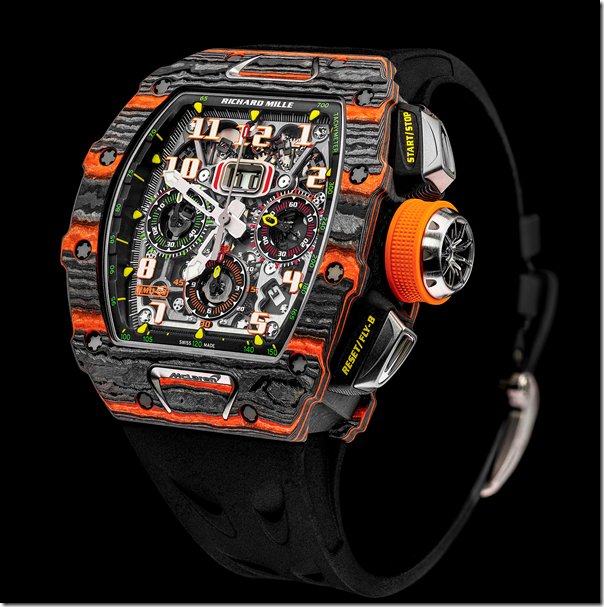
That’s the RM 11-03 McLaren Automatic Flyback Chronograph, which the company debuted at the 88th Geneva International Motor Show.
Even if we didn’t know that it is being produced in a limited edition of 500 watches and that it has a list price of 180,000 CHF (plus tax)—which is $190,863 U.S. (plus tax)—the watch, which is made with Carbon TPT interlaced with Orange Quartz TPT.
TPT is an acronym for “thin ply technology,” which is a material that is proprietary to watchmaker Richard Mille, which collaborated with McLaren on the project.
While McLaren Cars don’t seem to have an excessive line or a baroque filigree that is there for nothing but show, not go, this watch seems, well, gaudy.
Take this, for comparison, a McLaren 720S in Atlantic Blue by McLaren Special Operations, which was also introduced in Geneva:

Admittedly, it costs roughly $200,000 more than the watch (£281,260, or $390,965 (plus tax)), but clearly the design is nothing short of superb.
RELATED CONTENT
-
On Automotive: An All Electric Edition
A look at electric vehicle-related developments, from new products to recycling old batteries.
-
Things to Know About Cam Grinding
By James Gaffney, Product Engineer, Precision Grinding and Patrick D. Redington, Manager, Precision Grinding Business Unit, Norton Company (Worcester, MA)
-
TRW Multi-Axis Acceleration Sensors Developed
Admittedly, this appears to be nothing more than a plastic molded part with an inserted bolt-shaped metal component.