 Mexican Media Brands
Honda to Make Ventilator Compressors in Ohio
More good works in the fight against the coronavirus
#workforcedevelopment #Acura #labor
Share


When Honda opened its technical center in Marysville, Ohio, five years ago, the facility’s stated mission was to develop manufacturing skills for the future.
Now the center is putting those skills to use to help combat a more immediate concern: the global coronavirus pandemic. The initiative is the latest in a multi-pronged approach in Honda’s response to the coronavirus that also includes:
- Producing personal protection equipment for healthcare providers
- Donating $1 million to food banks
- Supporting “virtual volunteering” employee efforts
Ventilator Compressors
Honda aims to produce 10,000 compressors per month at the Marysville center. The carmaker is partnering on the project with Reading, Pa.-based Dynaflo, which designed the compressor.
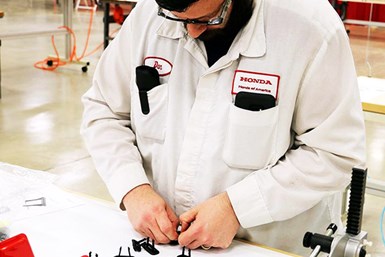
Honda worker in Ohio assembling compressor parts used in medical ventilators to treat COVID-19 patients. (Image: Honda)
There has been a severe shortage of ventilators, which are used to help treat COVID-19 patients with breathing problems, during the rapid spread of the virus throughout the U.S. over the last month. John Hopkins estimates that as many as 500,000 more will be needed.
Several other carmakers also have begun (or soon will) producing ventilators, including General Motors and Ford. GM shipped its first units this week. As with Honda, GM and Ford are partnering with ventilator specialists on their projects.
PPE Response
At the onset of the pandemic, Honda began inventorying what it had on hand at its various North American locations that could help medical professionals. The effort has resulted in 10 facilities shipping more than 200,000 items to hospitals and first responders. The booty includes:
- Gloves
- Face shields
- N95 protective masks
- Alcohol wipes
- Half-mask respirators
- Other protective gear
In addition, the carmaker has begun producing face shield frames with 3D printers at five of its facilities. Honda is partnering with 3D-printing specialist Stratasys, which launched its own COVID-19 response on March 22, on this program.
Honda engineers also are developing another way to produce the frames that involve using injection-molding processes. The equipment normally is used to make plastic components for Honda and Acura cars.
Food Support
Noting that experts predict there will be a huge gap in supplies at food banks as a result of the pandemic over the next six months, Honda is donating $1 million to food banks and meal programs to support those in need across the U.S., Canada and Mexico.
In addition, Honda will match donations to food banks made by individual employees at a rate of up to $1,000 per person.
Virtual Volunteers
Under the virtual volunteer initiative, Honda employees are helping people in their own communities from home using a computer, smartphone or other device. The program includes neighbor wellness checks over social media and coordinating remote group activities such as making non-medical grade masks.
Rick Schostek, executive vice president at Honda North America, detailed the various programs this week as part of a LinkedIn post. He notes that each of Honda’s business lines—automobiles, power equipment, power sports and aircraft—is contributing in some way to help combat the coronavirus.
“I have always found that difficult times, even tragic ones like this COVID-19 pandemic, can bring out the best in people,” Schostek says.
RELATED CONTENT
-
on Plenty of Things about Volkswagen & Other Topics, Too
On VW’s Project Trinity, transformation of product development and the interior of the ID.Buzz; new buses of interest; carbon fiber for wheels and accessories (non-automotive); and Aston Martin’s EV battery
-
Ford Details Plans to Refurbish Detroit Train Station
Ford Motor Co. says the centerpiece for its new advanced-mobility campus in Detroit’s historic Corktown district will be the former Michigan Central train station.
-
On a Baby Bugatti EV, a Hybrid Boat and the Future of Works
On the diminutive electric Bugatti you didn’t know you wanted; interesting predictions about apps, electrification and data; a Scandinavian hybrid tourist boat development; the VW Arteon sedan; and employment considerations in car plants as a result of electrification