 Mexican Media Brands
Crash!
It almost seems counterintuitive: a crash test that is about deceleration, not acceleration.
.jpg;width=70;height=70;mode=crop)
Share


It almost seems counterintuitive: a crash test that is about deceleration, not acceleration. But that’s part of the procedure used at the Transport Canada Motor Vehicle Test Center in Blainville, which is said to be one of the most advanced crash-test facilities in the world.
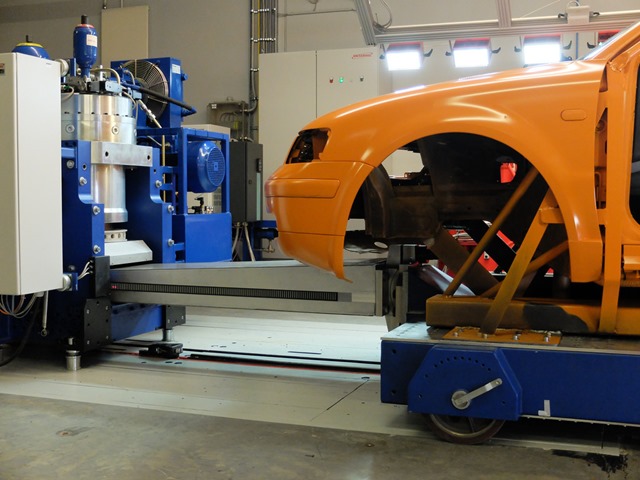
They’re using a something called a Hydrobrake. The vehicle is on a sled, which is accelerated toward the Hydrobrake that is at the barrier. There is a wedge on the front of the sled, and it enters the Hydrobrake through two brake shoes, displacing an upper brake piston into a hydraulic cylinder, thereby providing controlled deceleration through the regulation of the oil flow by a computer-aided controller. The pressure is a measure of the braking force that determines the deceleration.
According to Messring Systembau GmbH which provides the Hydrobrake system, a benefit of the deceleration crash is that the direction of the movement is synchronous with the crash, not inverse, as is the case with acceleration tests.
RELATED CONTENT
-
Robotic Exoskeleton Amplifies Human Strength
The Sarcos Guardian XO Max full-body, all-electric exoskeleton features strength amplification of up to 20 to 1, making 200 pounds—the suit’s upper limit—feel like 10 pounds for the user.
-
Increasing Use of Structural Adhesives in Automotive
Can you glue a car together? Frank Billotto of DuPont Transportation & Industrial discusses the major role structural adhesives can play in vehicle assembly.
-
On Fuel Cells, Battery Enclosures, and Lucid Air
A skateboard for fuel cells, building a better battery enclosure, what ADAS does, a big engine for boats, the curious case of lean production, what drivers think, and why Lucid is remarkable