

 Mexican Media Brands
First Look at the 2018 Honda Accord
“We are redefining the Honda Accord for a new generation of buyers by bringing something unexpected that challenges the idea of what a mainstream sedan can be.” That’s Jeff Conrad, senior vice president of the Automobile Div. of American Honda Motor Co., Inc., talking about the 10th generation, 2018 Accord that was unveiled today in Detroit and which will launch this fall.
#electronics #interior
.jpg;width=70;height=70;mode=crop)
Share


“We are redefining the Honda Accord for a new generation of buyers by bringing something unexpected that challenges the idea of what a mainstream sedan can be.”
That’s Jeff Conrad, senior vice president of the Automobile Div. of American Honda Motor Co., Inc., talking about the 10th generation, 2018 Accord that was unveiled today in Detroit and which will launch this fall.
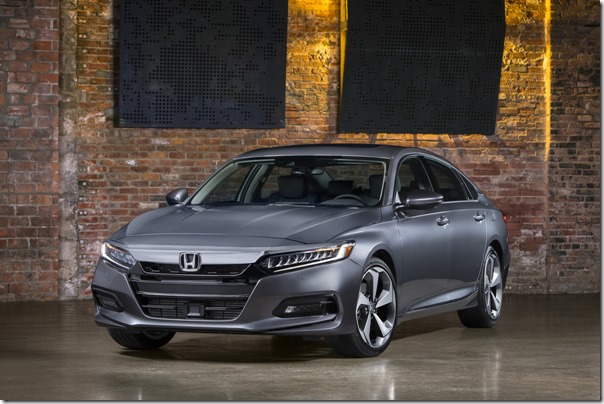
He went on to say: “Even as we advance core values like great driving dynamics, safety performance and efficiency, the distinctive design of this all-new 2018 Honda Accord will help it appeal to both head and heart in equal measure.”
Yes, the driving dynamics should be enhanced by things like a new Macpherson strut front suspension with L-shaped aluminum control arms mounted to an all-aluminum front subframe; a multilink rear suspension mounted to a floating rear subframe; a lower (0.39 inches) center of gravity; a longer wheelbase (+2.16 inches) and wider wheel tracks (+0.20 inches in the front and +0.79 inches in the back); and two new turbocharged four-cylinder engines, a 192-hp 1.5-liter and a 252-hp 2.0-liter (there is also a two-motor hybrid, but chances are that might fit into the “efficiency” category).
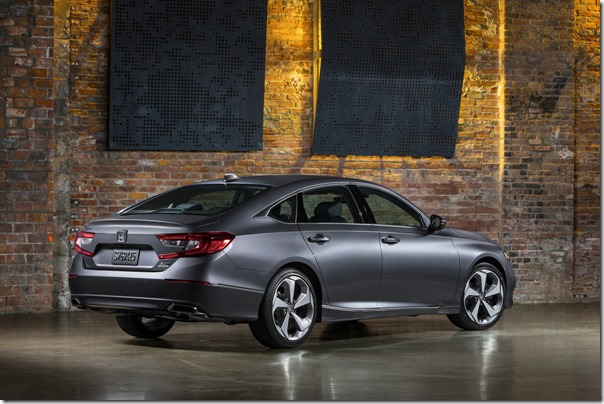
The safety performance is manifest in the Honda Sensing technologies—including Collision Mitigation Braking System (CMBS), Lane Departure Warning, Road Departure Mitigation, Adaptive Cruise Control with Low-Speed Follow, and Traffic Sign Recognition—as well as in the fundamental design and build of the body structure, which is based on Honda’s Advanced Compatibility Engineering and includes such things as a crash-stroke front frame and tailor-tempered rear frame members (the body-in-white is 29 percent ultra-high-strength steel).
But it is probably the design that will be the biggest draw for many people, as the sedan has gone from being, well, sedan-like in many regards to something that has a much sportier design, with shorter overhangs, a long hood, a sweeping greenhouse, and a lower (-0.59 inch), wider (+0.39 inch) body. The front fascia is more vertical and contains the chrome-wing grille with a big main air intake; the body sides have deeply sculpted lines.
Arguably, its design seems to have been inspired by the Civic, which is certainly not a bad thing, as Honda has sold 175,763 Civics during the first six months of 2017, making it second only to the Toyota Camry in car sales (176,897—and there is an all-new Camry, so things are going to get a bit more competitive in this midcar space). It should be noted that the Accord isn’t doing all that badly sales-wise, as with 160,091 for the first six months it is in fourth place in cars (behind the Toyota Corolla at 165,596).
The Accord will be produced at Honda of America Manufacturing’s plant in Marysville, Ohio—and Accords have been built there since November 1982.

RELATED CONTENT
-
Special Report: Toyota & Issues Electric
Although Toyota’s focus on hybrid powertrains at the seeming expense of the development of a portfolio of full battery electric vehicles (BEVs) for the market could cause some concern among those of an environmental orientation, in that Toyota doesn’t seem to be sufficiently supportive of the environment, in their estimation. Here’s something that could cause a reconsideration of that point of view.
-
On Traffic Jams, Vehicle Size, Building EVs and more
From building electric vehicles—and training to do so—to considering traffic and its implication on drivers and vehicle size—there are plenty of considerations for people and their utilization of technology in the industry.
-
On the Genesis GV80, Acura MDX, BMW iDrive and more
From Genesis to Lamborghini, from Bosch to Acura: new automotive developments.