

 Mexican Media Brands
Audi A6 Materials Use Awarded
Technically superb attributes of the engineering of the Audi A6 have recently been acknowledge in Europe with particular focus on the implementation of lightweight materials in the car.
#aluminum
.jpg;width=70;height=70;mode=crop)
Share


Technically superb attributes of the engineering of the Audi A6 have recently been acknowledge in Europe with particular focus on the implementation of lightweight materials in the car.
The A6 received the Doors & Closures Innovation Award from the Automotive Circle International, an organization with representation of vehicle manufacturers ranging from Adam Opel to Volvo.
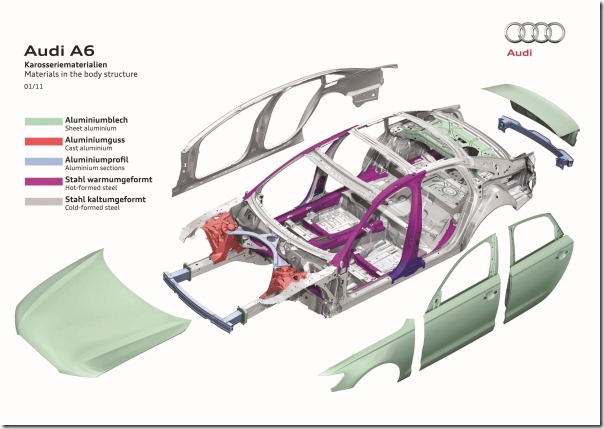
This was predicated on the development of double-shell stamped aluminum doors that are 20 kg lighter than those used in the previous A6. Credit was given to the use of simulation of the doors during development such that they were able to make the doors lighter while providing increased rigidity.
Automotive Circle International also gave the A6 second place in the EuroCarBody Award (with first going to the Hyundai i40, which is the same platform as the Sonata in the U.S.).
Here the A6 is credited with a weight reduction of 15% compared to the previous generation. This is achieved by using aluminum for more than 20% of the body structure, as well as for all of the hang-on parts (i.e., hood, decklid, doors). Also contributing to the weight save is the use of high-strength steels in the structure, such as in the safety cage area for the passenger compartment.
RELATED CONTENT
-
Aluminum Sheet for EV Battery Enclosure
As the number of electric vehicles (EVs) is about to increase almost exponentially, aluminum supplier Novelis is preparing to provide customers with protective solutions
-
Increasing Use of Structural Adhesives in Automotive
Can you glue a car together? Frank Billotto of DuPont Transportation & Industrial discusses the major role structural adhesives can play in vehicle assembly.
-
The Koenigsegg Jesko Has An Amazing Engine
It is hard to believe that this is a vehicle in “serial” production with such extraordinary powertrain performance