

 Mexican Media Brands
Advancing bonding, coating and sealing to 4.0 systems for composites, metals and more
Brighton Science uses decades of experience, 2-second surface measurements and a framework of data-based specs and KPIs to help manufacturers advance toward reliable, predictable bond quality for faster, high-performance production.

Share


Surface Analyst tools — both handheld and automated — measure the contact angle of a water droplet to assess a substrate’s surface energy, providing real-time quality control for bonding, coating, painting and sealing processes. Source (All Images) | Brighton Science

In advanced manufacturing, speed and reliability are absolutely critical. And almost every manufacturer, from aerospace to consumer electronics, relies on some type of bonding, coating, sealing or painting to produce their high-performance products.
In all of these processes, the surface energy of the material — the ability for the top three to five layers of molecules to form strong chemical bonds — determines success or failure. Flaking paint, disbonds and delaminating seals can lead to production delays, nonconformance reports, rework, scrap and possible failures in service. But a 2-second measurement on surfaces prior to processing can provide the data needed to ensure high-quality bonding of paints, coatings or adhesives to composites, plastics, metals and even ceramics. This simple technique can also be coupled with specifications and form the basis of automated and Industry 4.0 systems that apply AI to enable data-driven decisions across process lines, facilities and organizations.
The history and science
In 1996, Dr. Giles Dillingham founded Brighton Technologies Group (BTG, Cincinnati, Ohio, U.S.) as a materials science R&D lab. During work as a subcontractor to Boeing on the DOD’s Composites Affordability Initiative (CAI) program, BTG demonstrated lab techniques for detecting out-of-spec surfaces for adhesive bonding. At the time, there were no instruments to take such measurements in manufacturing or repair environments. Through a 2013 SBIR with the Air Force Research Lab (AFRL), BTG developed and patented Ballistic Drop Deposition and then created the Surface Analyst — the first handheld device for contact angle measurement of bonding surfaces in production/field settings. It was later used in the development of adhesive bonding for composites in the F-35 Joint Strike Fighter program.
BTG Labs went on to develop plasma polymerization processes for corrosion-resistant coatings, plasma surface treatments to improve bonding and plasma-deposited antimicrobial coatings for surgical instruments and building interiors. It also began working with companies on product quality and performance issues across a wide range of industries, growing its services and product offerings, and was renamed Brighton Science in 2022.
“We’ve spent decades understanding the relationship between surface treatment, surface energy and bonding performance,” says Andy Reeher, CEO of Brighton Science. “We refer to adhesive bonding as chemical fastening because the top few layers of molecules on both substrates’ surfaces chemically bond with the top few molecular layers of the adhesive. The result is an extremely durable bond that lasts for many decades. There are numerous adhesive bonds in everything from cars and planes, to satellites, your iPhone and even bridges. This same chemical fastening takes place when applying coatings, paints and sealants. But all of these processes require surfaces that are extremely clean and attractive to molecules in the material being applied.”

The key to good bonds is high surface energy — indicated by low contact angle. Surface Analyst tools accurately measure this on composites, metals, plastics and ceramics as well as on textured and plasma-treated surfaces.
The key measurement of this quality is called surface energy. When a surface is clean, it emits high energy, and water — itself a high-energy molecule — spreads out on that surface as it is attracted to those high-energy molecules. Contamination results in a low-energy surface, causing water to bead up, attracted more to itself than the surface. Thus, measuring the contact angle of a water droplet on a surface measures the surface energy — high contact angle means low surface energy while a low contact angle indicates a more ideal surface for bonding.
“This is the science embodied in our Surface Analyst tools,” says Reeher. “It uses inkjet technology to print sub-millimeter drops of liquid on a surface and then quantitatively analyzes their contact angles to provide a very sensitive and precise measurement.” It’s also very easy to use, he adds. “You just place the inspection head against the surface, pull the trigger and look at the results screen.”
Objective, reliable measurement
One of the key benefits of the Surface Analyst tools, notes Reeher, is that they’re not subjective like traditional methods such as dyne ink and water break tests. “Dyne ink tests require user interpretation and can contaminate surfaces, and while a water break test is also subjective, it only detects hydrophobic contaminants. It isn’t able to quantify surface energy or detect residues that are hydrophilic or act as surfactants.”
“Our systems are also not limited to the lab,” says Reeher. “When we developed the Surface Analyst, it was the first time you could take readings on a vertical flange, upside down, deep into a crevice or on curved surfaces. We could finally measure surface energy in real world production. It also increases accuracy.”

The BConnect software platform links all Surface Analyst devices into a networked system to refine pass/fail standards, track trends and compare production lines or facilities.
This is thanks to its patented Ballistic Drop Deposition technology. Measurements on rough surfaces were historically an issue because drops could be pinned between features during deposition, affecting the contact angle. “Our technology fires multiple nanodroplets with kinetic energy that advances them over the edges of such surface features as the sub-millimeter drop forms,” he explains. “The result is a round, stable drop that behaves as if the surface were smooth, providing reliable measurements even for textured and nonhomogeneous surfaces.”
Brighton Science offers handheld and automated Surface Analyst systems as well as its BCmobile and BCinline versions which can be integrated with its BConnect software platform. This enables an organization to link all of its Surface Analyst devices into a networked system where users can track trends, set pass/fail standards, configure alerts when surface data drifts out of spec and monitor processes across different facilities or production lines.
“Surface Intelligence”
The surface energy measurements from these instruments are a key part in controlling the quality of surfaces for reliable bonding. However, the companies that do this well, notes Reeher, create a system for implementing this data in specifications, KPIs and, eventually, predictive analytics. Brighton Science calls this “Surface Intelligence” and has developed a framework that organizations can use to evaluate where they are now and how to step toward more advanced control and performance.
“We’ve learned that bond failures are most often due to a lot of complex environmental circumstances and/or human choices,” explains Reeher. “It could be unseen contamination on incoming materials, equipment drifting out of spec or timing gaps and surface aging due to unforeseen events or issues in the plant. There are hundreds of variables. Even subtle variations in products from suppliers can lead to failures that aren’t apparent until the part comes off the line or the customer has been impacted. Many companies have processes for surface preparation, but they don’t necessarily have the tools or structures in place to reliably diagnose or prevent bonding issues from the myriad variables involved.”
Surface Intelligence uses surface energy data as a common language to enable discussion and alignment between people, process steps, departments and suppliers. “When something’s gone bad, no one typically thinks they are the cause,” notes Reeher. “You have different people inside and outside the company pointing at each other. But data ends debate. We’ve seen many times that having surface energy data from throughout the process and value chain can identify if surface quality was indeed a root cause of the problem. And if it was, then you can also see where the issue is occurring, set a spec around it, monitor it and control it.”

Because surface energy can be affected by steps throughout a part’s process chain, identifying the critical points for measurement is key to achieve true control of surface quality.
Critical control points. “It’s not uncommon for people to think that the only point where surface quality is affected is in the surface prep before a coating, sealant or adhesive is applied,” says Reeher. “But in reality, issues can stem all the way from material manufacture and transport through storage and handling as well. One of the first ways companies can improve their Surface Intelligence is to identify all of these critical points where taking 2-second surface energy measurements gives them a basis for tracking issues and implementing control.”
Establishing specifications and KPIs. The next step is making sure specifications are based on data. “Ideally, the specification is developed at the same time as the production line,” says Reeher. “But we often work with companies who are doing this retroactively.” Most companies already have a performance goal — e.g., this bonded stringer must resist this ultimate load and number of fatigue cycles, or this coating must withstand these environmental conditions for X years.
“From these experiments and analysis, you can then define upper and lower control limits for the surface energy data,” says Reeher. “For example, prior to bonding or coating, the contact angle must be 30° ±3° or
SIMM framework

The Surface Intelligence Maturity Model (SIMM) that Brighton Science has developed gives companies a way to visualize the people, process and technology aspects of surface quality control and steps they can take for improvement.
“The companies we work with are in a range of stages,” says Reeher. “Some really aren’t aware of surface energy as a data point for quality, while others have a specification for surface prep, but it doesn’t include surface energy. But we also have customers that are measuring surface energy in production for a ‘go/no go’ kind of an approach. And then some are tracking surface energy as part of their quality program and comparing production lines or different plants, but that’s not the majority. At least, not yet. So, we needed a way to help companies see that there is a framework for progress. They need to be able to assess where they are, and visualize where they want to be and how to get there.”
This is why Brighton Science has developed the Surface Intelligence Maturity Model (SIMM). “It consists of a series of stages or steps that are defined by a people question, a process question and a technology question,” he explains. “As manufacturers move through these steps, they put the structure, specifications and KPIs in place to first measure process variability and then develop ways to reduce it. And they start seeing real results, including faster root cause analysis and implementing solutions as well as lower defect rates. Companies then see the improvement and opportunity that’s possible by going to the next stage."
Case histories: LTA, F-35
Even though bonding is not a new process, nor are the related processes of coating and sealing, they are still transitioning to a physics-based approach for quality control that is quantifiable and predictable. Examples of where this transition has already happened include painting and coating thickness control, where visual coverage checks and anecdotal experience for “one more coat” has been replaced with inline thickness gauges and dry film thickness specs. Semiconductor manufacturing has also moved through this transition — visually clean has been replaced with ISO standards, particle counts and surface contamination specifications.

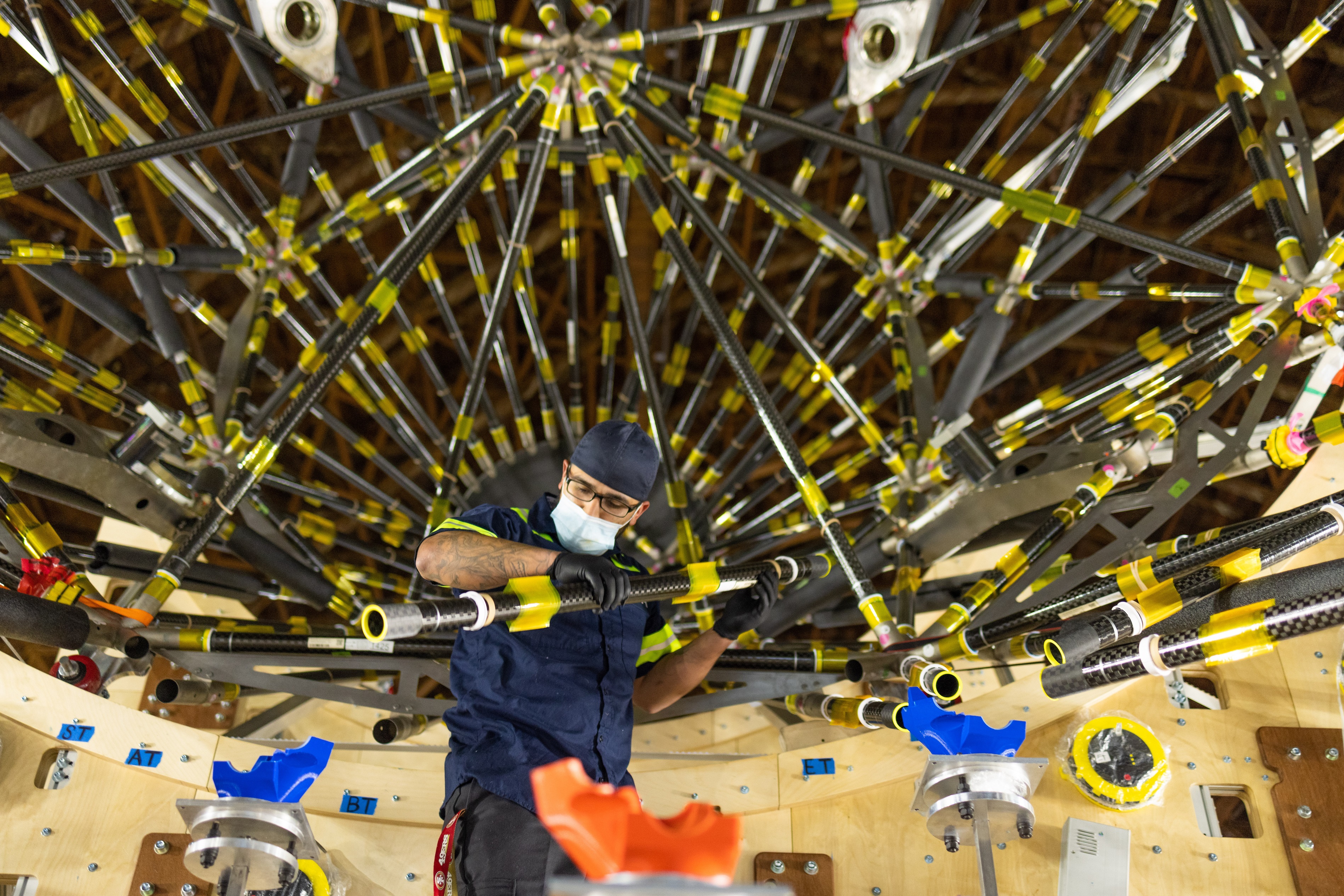
This automated system (top) shows a Brighton Science Surface Analyst (black box on left) checking surface energy of printed circuit boards after plasma treatment (silver cylinder on right). Surface Analyst measurements were key in more than 40,000 bonds during the assembly of the Pathfinder 1 airship’s frame comprising 10,000 CFRP tubes (bottom). Source | Lighter Than Air (LTA) Research
Lighter Than Air Research (LTA, Mountain View, Calif., U.S.) created its Pathfinder 1 airship (see “Next-generation airship design enabled by modern composites”) using 10,000 carbon fiber-reinforced polymer (CFRP) tubes. Scientists from Brighton Science worked with LTA to help qualify materials and processes, and LTA assembly technicians also used Brighton’s Surface Analyst tools to measure the inside of the tubes as well as more than 40,000 bonded tabs during the assembly process. “This support helped LTA achieve the highest quality bonds as they scaled their production techniques and achieved their airworthiness certification in 2023,” says Reeher. The company began flight testing shortly after and expanded the Pathfinder 1’s flight range in 2025.
Another key case history is the F-35 fighter jet. A large number of adhesively bonded fasteners are used in the assembly of each aircraft. To achieve predictable bonds, technicians use Brighton’s Surface Analyst tools to verify that they have adequately prepared the surface. Surface Analyst units are also used in the field to help assure high-quality bonds during aircraft maintenance.
Click Bond, AI and making all bonds more predictable
Brighton Science and Click Bond (Carson City, Nev., U.S.) have worked together on the F-35 and many other programs. Click Bond not only supplies bonded fasteners but is now advancing automation and digital tools to bring scalability and repeatability to composites and aerospace assembly (see “Bonded fastening meets the digital factory”). After decades of working together on many programs, Click Bond has acquired Brighton Science, which will continue to operate independently.
“Brighton Science brings scientific expertise to our engineering and manufacturing capabilities,” says Brandon Perlich, president and CFO of Click Bond. “Together, we’ll make bonding even more reliable and scalable across every industry we serve.”
“Together, our companies will deliver new innovations for advanced manufacturing,” adds Reeher. “We share a vision for what our developing technologies can achieve, including using insights from application of Brighton Science’s surface energy tools to inform future products and customer solutions with Click Bond.”
“Surface energy is a really important factor for so many processes,” he continues, “and yet, in these processes, it often hasn’t been well defined. But over three decades now, we’ve enabled measuring surface energy in production. And we’re working through the SIMM steps with customers who are now making more predictable bonds. Our goal is to make all bonds more predictable, and this is also where AI fits in.”


In 2026, Brighton Science was acquired by Click Bond, which is already advancing assembly with digitally connected tools and data streams aimed to speed production while improving safety, quality and performance. Source | Click Bond video
The basis for this development is Brighton Science’s BConnect platform. “It connects the surface energy data with environmental sensors and metadata, so you have one central data repository with environmental, process, production line and supply chain context,” Reeher explains. “Companies can move beyond disconnected datasets toward meaningful insights. And the consistent data structures BConnect creates can then enable AI tools for analysis. We are looking at now being able to detect patterns in variability and alert teams before a control limit is passed; to optimize process windows and enable adaptive processes that maintain performance with less interruption and scrap; to enable true digital traceability and to predict things like long-term performance and recommended maintenance intervals. AI is a huge frontier, and we’re doing a lot of work in that space.”
The aerospace industry, and composite parts supply chains specifically, face growing pressure to increase production rates. “As companies work to make their processes go faster, it’s crucial to fundamentally understand them and exert process control that actually achieves speed without sacrificing quality or increasing cost,” says Reeher. “There’s just no time to repeat and redo cleaning, surface prep or application for the thousands of adhesive bonds, coatings and sealants — to metals and composites — that are critical during aerostructures assembly. We are working with companies every day to help them transition to the next generation of advanced manufacturing.”